🚚 Free Worldwide Shipping on All Orders!Shop Now
1 / 6
+1
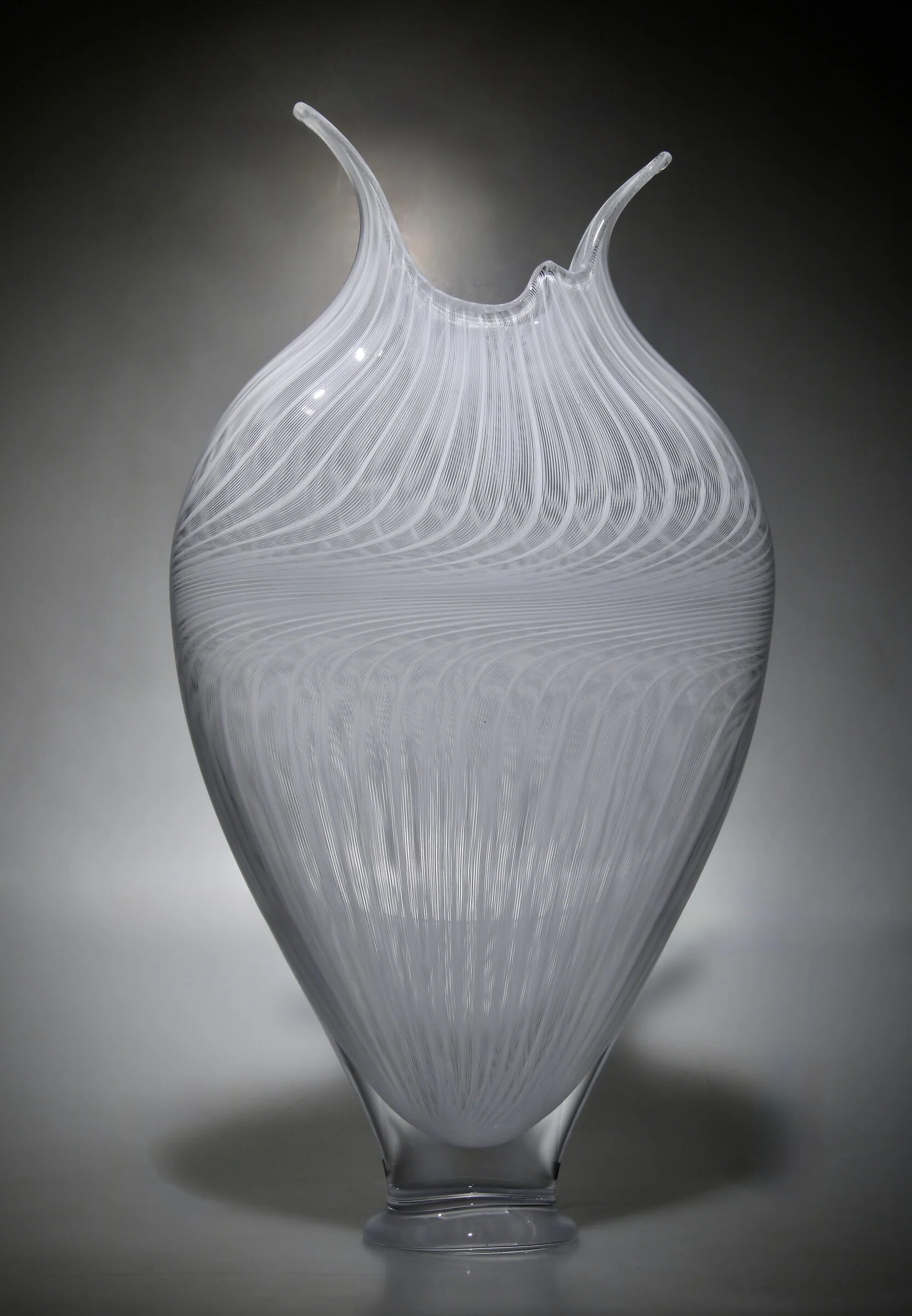
Zanfirico Twist Foglio - White
This blown glass vessel from Patchen's "Foglio" series is created with the involved zanfirico cane technique.
First, Patchen makes "filigree" cane, by encasing a rod of white glass in molten clear glass then stretching it 50-60', reducing its diameter to a pencil. After cooling, the rod is cut into many 6" lengths; with about 50 of them arranged parallel on a ceramic plate, they are then reheated and rolled onto a molten glass core again. This is then re-pulled into a similar sized rod, reducing the lines into tiny threads. Once these are again cut up, they can be rolled onto a blowpipe. Closing the end creates a striped bubble which Patchen can then twist and manipulate the create the wavy white lines in this work.
After gathering molten clear glass on top of this pattern, the final shape is blown. Few artists have mastered this technique to the degree that David Patchen has, as evidenced by his large and precise work and his standing in the glass world.
Since this Foglio has been double-encased, it is significant with great three-dimensional optics and depth. The flared base provides great stability; museum wax is recommended if added security is desired.
First, Patchen makes "filigree" cane, by encasing a rod of white glass in molten clear glass then stretching it 50-60', reducing its diameter to a pencil. After cooling, the rod is cut into many 6" lengths; with about 50 of them arranged parallel on a ceramic plate, they are then reheated and rolled onto a molten glass core again. This is then re-pulled into a similar sized rod, reducing the lines into tiny threads. Once these are again cut up, they can be rolled onto a blowpipe. Closing the end creates a striped bubble which Patchen can then twist and manipulate the create the wavy white lines in this work.
After gathering molten clear glass on top of this pattern, the final shape is blown. Few artists have mastered this technique to the degree that David Patchen has, as evidenced by his large and precise work and his standing in the glass world.
Since this Foglio has been double-encased, it is significant with great three-dimensional optics and depth. The flared base provides great stability; museum wax is recommended if added security is desired.
This blown glass vessel from Patchen's "Foglio" series is created with the involved zanfirico cane technique.
First, Patchen makes "filigree" cane, by encasing a rod of white glass in molten clear glass then stretching it 50-60', reducing its diameter to a pencil. After cooling, the rod is cut into many 6" lengths; with about 50 of them arranged parallel on a ceramic plate, they are then reheated and rolled onto a molten glass core again. This is then re-pulled into a similar sized rod, reducing the lines into tiny threads. Once these are again cut up, they can be rolled onto a blowpipe. Closing the end creates a striped bubble which Patchen can then twist and manipulate the create the wavy white lines in this work.
After gathering molten clear glass on top of this pattern, the final shape is blown. Few artists have mastered this technique to the degree that David Patchen has, as evidenced by his large and precise work and his standing in the glass world.
Since this Foglio has been double-encased, it is significant with great three-dimensional optics and depth. The flared base provides great stability; museum wax is recommended if added security is desired.
First, Patchen makes "filigree" cane, by encasing a rod of white glass in molten clear glass then stretching it 50-60', reducing its diameter to a pencil. After cooling, the rod is cut into many 6" lengths; with about 50 of them arranged parallel on a ceramic plate, they are then reheated and rolled onto a molten glass core again. This is then re-pulled into a similar sized rod, reducing the lines into tiny threads. Once these are again cut up, they can be rolled onto a blowpipe. Closing the end creates a striped bubble which Patchen can then twist and manipulate the create the wavy white lines in this work.
After gathering molten clear glass on top of this pattern, the final shape is blown. Few artists have mastered this technique to the degree that David Patchen has, as evidenced by his large and precise work and his standing in the glass world.
Since this Foglio has been double-encased, it is significant with great three-dimensional optics and depth. The flared base provides great stability; museum wax is recommended if added security is desired.
$909.65
Original: $2,599.00
-65%Zanfirico Twist Foglio - White—
$2,599.00
$909.65Description
This blown glass vessel from Patchen's "Foglio" series is created with the involved zanfirico cane technique.
First, Patchen makes "filigree" cane, by encasing a rod of white glass in molten clear glass then stretching it 50-60', reducing its diameter to a pencil. After cooling, the rod is cut into many 6" lengths; with about 50 of them arranged parallel on a ceramic plate, they are then reheated and rolled onto a molten glass core again. This is then re-pulled into a similar sized rod, reducing the lines into tiny threads. Once these are again cut up, they can be rolled onto a blowpipe. Closing the end creates a striped bubble which Patchen can then twist and manipulate the create the wavy white lines in this work.
After gathering molten clear glass on top of this pattern, the final shape is blown. Few artists have mastered this technique to the degree that David Patchen has, as evidenced by his large and precise work and his standing in the glass world.
Since this Foglio has been double-encased, it is significant with great three-dimensional optics and depth. The flared base provides great stability; museum wax is recommended if added security is desired.
First, Patchen makes "filigree" cane, by encasing a rod of white glass in molten clear glass then stretching it 50-60', reducing its diameter to a pencil. After cooling, the rod is cut into many 6" lengths; with about 50 of them arranged parallel on a ceramic plate, they are then reheated and rolled onto a molten glass core again. This is then re-pulled into a similar sized rod, reducing the lines into tiny threads. Once these are again cut up, they can be rolled onto a blowpipe. Closing the end creates a striped bubble which Patchen can then twist and manipulate the create the wavy white lines in this work.
After gathering molten clear glass on top of this pattern, the final shape is blown. Few artists have mastered this technique to the degree that David Patchen has, as evidenced by his large and precise work and his standing in the glass world.
Since this Foglio has been double-encased, it is significant with great three-dimensional optics and depth. The flared base provides great stability; museum wax is recommended if added security is desired.